
Women’s Sports Pioneer, Social Justice Advocate, Dedicated Volunteer
by Anne Kiefer
Nancy Schieffelin (1944 – ), Founding Mother of women’s college ice hockey, is also a civil rights activist, social justice advocate, and committed volunteer. Ice hockey has been a lifelong passion, but she counts her 1964 Freedom Summer in Mississippi as the experience that defines her life. During those months she worked alongside Black Americans struggling to overcome poverty and voter suppression. They inspired her to spend the rest of her life living generously, and to open doors for others to sports, to wellness, and to productive living.
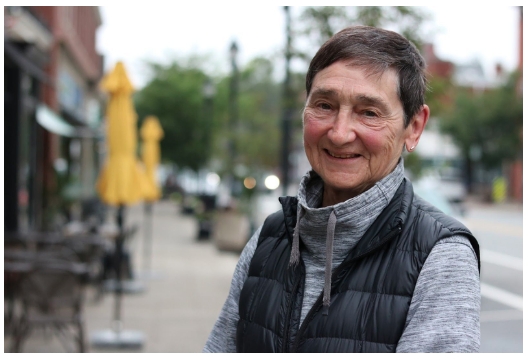
(Mary Byrne/Belmont Voice) June 27, 2025
Early Years
Born in 1944, Nancy enjoyed a privileged upbringing in New Jersey. Her ancestors include John Jay, first Chief Justice of the Supreme Court, and Commodore Cornelius Vanderbilt. Mark Twain is part of her family tree. Like her parents before her, she attended elite, private schools and was on a path to graduate from an Ivy League or Seven Sisters college. The family’s wealth, status and connections not only supported Nancy, but served to isolate and protect her from difficult realities that she would not learn about until her college years.
Although Nancy’s childhood and adolescence during the 1950s and ‘60s might conjure images of a polished debutante, Nancy was anything but demure. She describes her young self as “a huge jock.” She loved all sports, even the ones reserved at that time for boys, and she joined them in football, baseball, and hockey. She was so enamored with athletic competition that she was certain that sports, not college, was her future: “For the longest time, I never even thought I’d go to college. I thought, ‘Oh college, I just want to do sports.’ Seriously.”
Nancy’s love for ice hockey blossomed early. She played “pond hockey” as a seven-year-old with the neighborhood boys, and by age eight she had joined an organized boys’ team. With the encouragement of her progressive parents, who funded her equipment and drove her to practice, she played club hockey for years, always as the only girl. By her late teens, though, she faced a decision. Should she continue as the lone girl in a sport considered a boys-only activity, that now presented significant physical and social challenges? Or should she focus on the sports in which she excelled at her all-girls high school? Nancy chose to abandon ice hockey at that point and concentrate on field hockey, basketball, and tennis for her school teams.
Nancy summed up her love of sports and team competition for her 2022 induction into the Kent Place School Athletics Hall of Fame:
“Athletics gave me direction, built my confidence, instilled values of discipline, respect, fairness, perseverance, and the courage to take risks. I could experience the thrill and satisfaction of making that perfect pass or shot. All these qualities spilled into the rest of my life. Athletics empowered me.”
College Career
Despite her earlier feelings about college, Nancy enrolled at Pembroke, the women’s college of Ivy League Brown University, as a freshman in 1963. She played varsity field hockey, but her love for ice hockey reignited when she saw the new state-of-the-art ice rink, home of the Brown men’s ice hockey team. To gain access to the rink, she opted to take ice skating as her winter term gym class.
Initially the class bored Nancy, an expert skater. “I couldn’t stand it just skating.” She got her gym teacher’s permission to bring her hockey stick and puck to class. Soon she was charging around the rink, guiding the puck across the ice, dodging the other women practicing basic skills and figures.
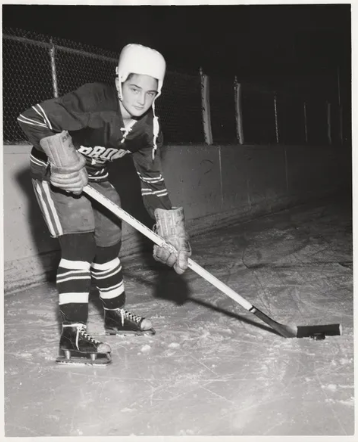
The men’s hockey coach, Jim Fullerton, observed her on the ice one day. He realized her talent, and invited her to a practice session—incognito—with the men’s team. The athletic risk-taking and empowerment of which Nancy spoke at her Hall of Fame induction must have been at work then because she agreed. The practice and ‘big reveal’ of Nancy’s identity was recorded and photographed by a reporter from the Providence Journal.
At the time, the men’s team was despondent from a string of recent losses. There were a couple of competing motives attributed to Fullerton’s stunt. Was Fullerton’s motive in having Nancy scrimmage with the team an unspoken, sexist ‘you play like a girl’ jibe meant to shame them into putting forth more effort on the ice? Or was her initial disguise a way to circumvent the team’s preconceived ideas about women and hockey, and prove to them that women have the skills and mindset to play the aggressive, physically demanding sport?
Even Nancy equivocates, saying that it’s a “conundrum.” But she was ecstatic about playing hockey again and about the results: the men were impressed with Nancy’s skill and acknowledged that women could handle the rough and tumble of hockey. More importantly, that event sparked Nancy’s determination to form a Pembroke women’s team.
Nancy started a recruitment drive for players. That first women’s college ice hockey team, the Pembroke Pandas, was a mix of field hockey players, figure skaters, and Nancy, the one accomplished hockey player.
The field hockey players were mediocre skaters, but familiar with team play and game rules. The figure skaters were excellent on the ice, but ignorant of hockey rules and unfamiliar with team play. The Pandas’ “competition” that year was limited to scrimmaging each other. But of that team, Nancy says, “We were just a ragtag group of women who were having a lot of fun.”
Women’s Hockey Is Established
Within five years after that bumbling Pandas team took the ice, other colleges formed women’s teams and intercollegiate competition began. In 1995, Belmont High School outside Boston formed the first varsity girls hockey team and Nancy, whose children attended Belmont public schools, became a huge fan. Within 35 years, the first US Olympic Women’s Hockey Team participated in the 1998 Winter Games, capturing the gold medal. The women’s team has medaled in every Winter Olympics since 1998, winning gold again in 2018 and 2026.
Thus, Nancy Schieffelin planted the seeds for women’s hockey to flourish in the US. But in an extraordinary turn of events, after her sophomore year she ditched hockey for a second time, and dropped out of college. She never saw the Pembroke Pandas officially recognized and never played in a sanctioned game as part of the team. The courage and risk-taking she attributes to athletics took her in a completely different direction.
A Pivotal Experience
While Nancy was recruiting for the Pandas in 1964, she was also being recruited herself at Pembroke for an endeavor completely different from anything she had ever done. She volunteered to travel to Mississippi after her freshman year for the 1964 Freedom Summer project, an effort organized by a coalition of civil rights organizations to improve educational opportunities for Black students and to register Black citizens to vote.
White racial prejudice and race-based violence were rampant throughout Mississippi in 1964, making Freedom Summer a dangerous undertaking for the organizers, volunteers, and members of the community with whom the volunteers lived and worked. Nancy and her family recognized the importance of the effort, however, and she was supported by her parents in her determination to participate. During her time in Mississippi, Nancy helped set up a Freedom School and library, and register voters in the Mississippi Freedom Democratic Party.
Nancy described 1964 Mississippi for a November 2023 edition of the Brown Daily Herald:
“I’d never seen anything like the poverty and the kind of oppressive sense that people here had no opportunities. And it was extremely dangerous, just for them to have me in their house or in that neighborhood. They were risking their lives.”
Armed white men frequently prowled the neighborhood of the Black family with whom she was staying.
During a 2014 taped interview with Freedom Summer veterans, Nancy said in a soft, self-effacing voice that her experience angered and “radicalized” her. She was awakened to the systemic racism, wealth inequality, and disenfranchisement that Black people in the US endured, and she became acutely mindful of the flip side—that whiteness had afforded her considerable privilege. “It opened my world.” Simultaneously she witnessed the love and solidarity of Black communities, a caring that was extended to the white volunteers who came to work with them.
Nancy also became conscious of the gender boundaries that had been set around her life. “Being in Mississippi…freed me up to be more… be more expressive… as a woman and in terms of racial issues.”
Nancy returned as a sophomore to Pembroke in the fall, but in the wake of her Freedom Summer experience, she became disillusioned with life in that Ivy League environment. “I did try to come back. The campus at the time, it seemed such a contrast to what I had been through and what I was dealing with that it was like surreal. This is just so safe, and rich, and I grew up in that kind of environment.”
Notably, she lost interest in hockey. “I was thinking hockey, you know, at that point, I just, it didn’t compute for me, I didn’t want to. It just seemed so frivolous and unimportant.”
Nancy was a dean’s list student as a freshman. As a sophomore trying to readjust to Pembroke after Mississippi, she struggled academically. She dropped out of college after her sophomore year and moved to the Roxbury neighborhood of Boston, the heart of the city’s Black community. She worked for a year, returned to school at Boston University to study social work, and then pursued a career in that field. In addition to her professional work, Nancy donated her time and talent through the next decades of her life to a number of volunteer organizations.
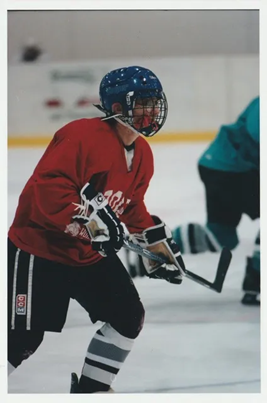
Nancy finally returned to hockey. “Eventually, I can’t remember when, I picked up a stick and started playing again. I played through my 30s, 40s, 50s, 60s and early 70s with various teams—teams like the Motherpuckers, the Ice Sharks, and the Zambeauties.”
Living Generously
Nancy’s return to hockey was accompanied by its incorporation into community service, evidence that although hockey was hugely important to her, Freedom Summer had been singularly instrumental in informing her adult life. One of her favorite volunteer activities is coaching youth hockey in inner-city Boston. In addition, she volunteers for the Women’s Lunch Place, a daytime shelter for homeless and low-income women, and she supports young people facing barriers to success through her volunteer work for the YouthBuild program.
Nancy Schieffelin’s Legacy
Nancy Schieffelin has left a remarkable legacy, of which her contribution to women’s hockey in the US is but one aspect. Every member of the 2026 Olympic gold-winning Women’s Hockey Team honed their skills playing on a college team. They have Nancy Schieffelin, the Founding Mother of women’s collegiate hockey, to thank for the opportunity.
Since 1995, thousands of inner-city Boston children from families with limited resources have learned to play hockey with the SCORE Boston Hockey program. The five to eight-year-old “mites” can thank Coach Nancy Schieffelin for their introduction to the sport.
For almost fifty years, hundreds of thousands of low-income, undereducated, underemployed teens and young adults across the globe have been able to overcome societal barriers and become productive community leaders through the YouthBuild program. Nancy Schieffelin’s dedication to the project and her tireless fundraising help make their achievements possible.
Nancy Schieffelin—women’s hockey icon, civil rights advocate, and inspired volunteer—transcended gender, racial, and social norms that contradicted her value system and threatened to limit her future. She instead defied expectations and channeled her unique talents, her love of hockey, and her remarkable Freedom Summer into a life of service to others.
 Finger Lakes Justice Partnership
Leave a comment